

Quick Verdict
Test your favorite shirt at home to see if it bounces back after a pull.
How to Try It
This simple test shows you how well a fabric returns to its original shape.
What You Need and How It Works
• First, mark a spot on your garment with a pen.
• Next, attach a small weight (like a book or a dumbbell) to that spot.
• Watch the fabric slowly return to its normal size.
Why It Matters
Clear numbers reveal how much the fabric recovers. This test gives you confidence that your clothes will keep their shape, wash after wash.
Quick Guide to Testing Clothing Stretch Recovery at Home
First, choose a flat spot on your garment and mark a section along the fabric grain (the natural line the fabric follows) at its unstretched length. For example, use a washable fabric marker to place two marks exactly 4 inches apart. This distance is your original measurement.
Next, apply a controlled stretch to the fabric. Clip or clamp a 200 g weight to the marked section and let it hang for about 10 seconds. This should stretch the fabric by about 20 to 30 percent, so your 4-inch mark should now show roughly 4.8 to 5.2 inches. Did you know that small changes in stretching can affect how long the fabric lasts?
After you remove the weight, check how well the fabric recovers by measuring the distance between your marks twice: once after 30 seconds and then again after 5 minutes. The difference between the stretched measurement and the post-stretch measurements tells you how well the fabric bounces back.
Finally, work out the recovery rate using this formula: (recovered length – original length) / (stretched length – original length) × 100. For example, if the fabric rebounds to 4.6 inches from an original 4 inches after being stretched to 5 inches, these numbers show how resilient it is. Fabrics that bounce back 85 to 95 percent in 5 minutes usually perform well. If the permanent gap left after recovery is under 10 percent, it means the fabric has a strong memory and reliable elasticity, so your clothing will stay in shape over time.
Essential Tools for Home Clothing Stretch Recovery Tests
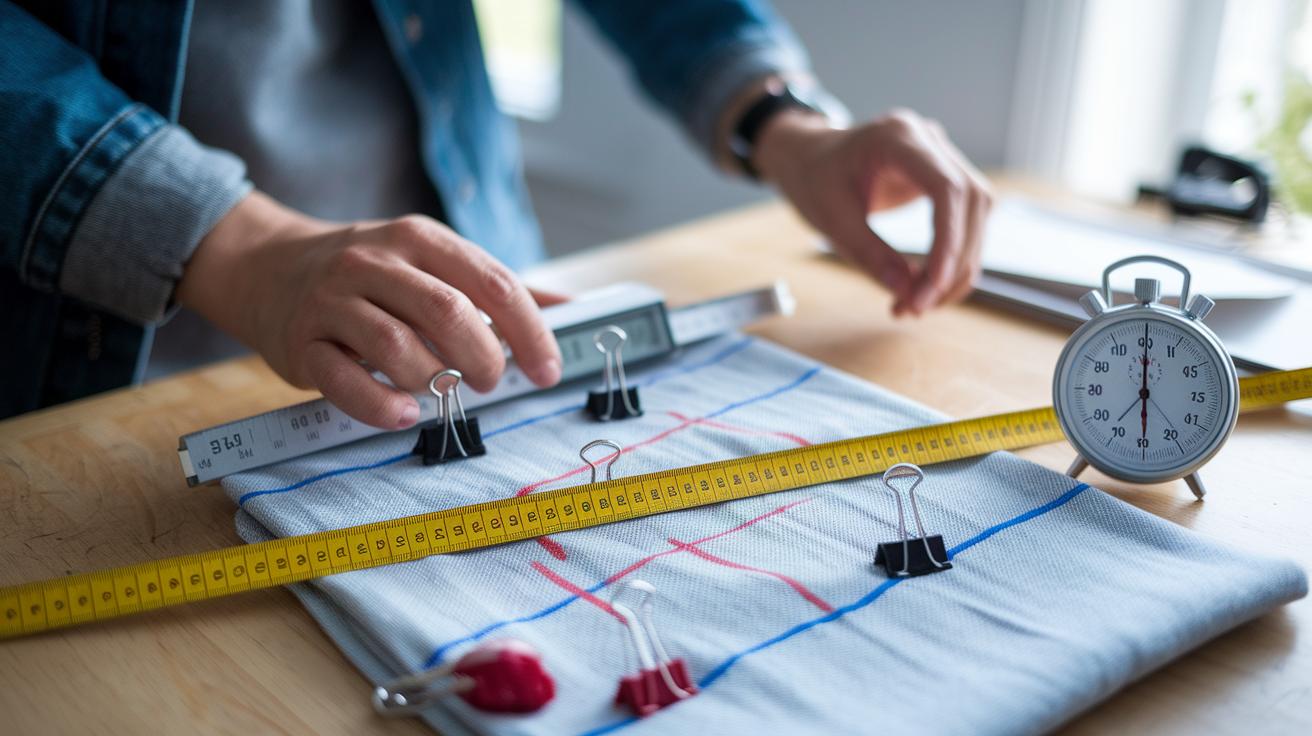
For a solid home clothing stretch test, the right tools can make a big difference. Start with a flexible measuring tape marked in 1/16 in increments. This helps you catch even the smallest shifts in your fabric.
Next, use a digital caliper that measures to 0.01 in. This tool finds tiny differences that a regular meter might miss. You will also need weights from 100 g to 500 g to apply a steady pull. You can secure your fabric with binder clips or small clamps while the weight does its work.
Mark your test area with a washable fabric marker. Clear marks ensure you always measure the same spot. Then, use a stopwatch to time both the stretch and the recovery period. If you want even more detail, try recording the test with your smartphone's slow-motion feature.
This set of tools gives you a reliable way to check fabric flexibility at home, making your DIY textile evaluation easy and accurate.
Step-by-Step Clothing Stretch Recovery Test Methods at Home

-
Wash and Prep
Start by washing your garment following the care label and drying it flat. This resets the fabric to its natural state by removing any previous stretching. -
Mark Baseline
Using a washable marker, draw two marks exactly 4 inches apart along the fabric grain. This makes sure every test begins at the same spot. -
Apply Stretch
Clamp the fabric securely with clips or clamps and attach a 200 g weight (about 7 ounces). Keep the weight on for 30 seconds to stretch the fabric. -
Measure Recovery
Take the weight off and measure the distance between your marks at 30 seconds and again at 5 minutes. This shows both the immediate and the settled recovery of the fabric. -
Calculate Recovery Metrics
Subtract the original measurement from the recovered measurement. Then, divide by the difference between the stretched length and the original length and multiply by 100. For example, if the fabric starts at 4 inches, stretches to 5 inches, and recovers to 4.6 inches, then (4.6 – 4) divided by (5 – 4) multiplied by 100 gives a 60% recovery and a 40% permanent stretch.
Test Clothing Stretch Recovery at Home: Feel Assured
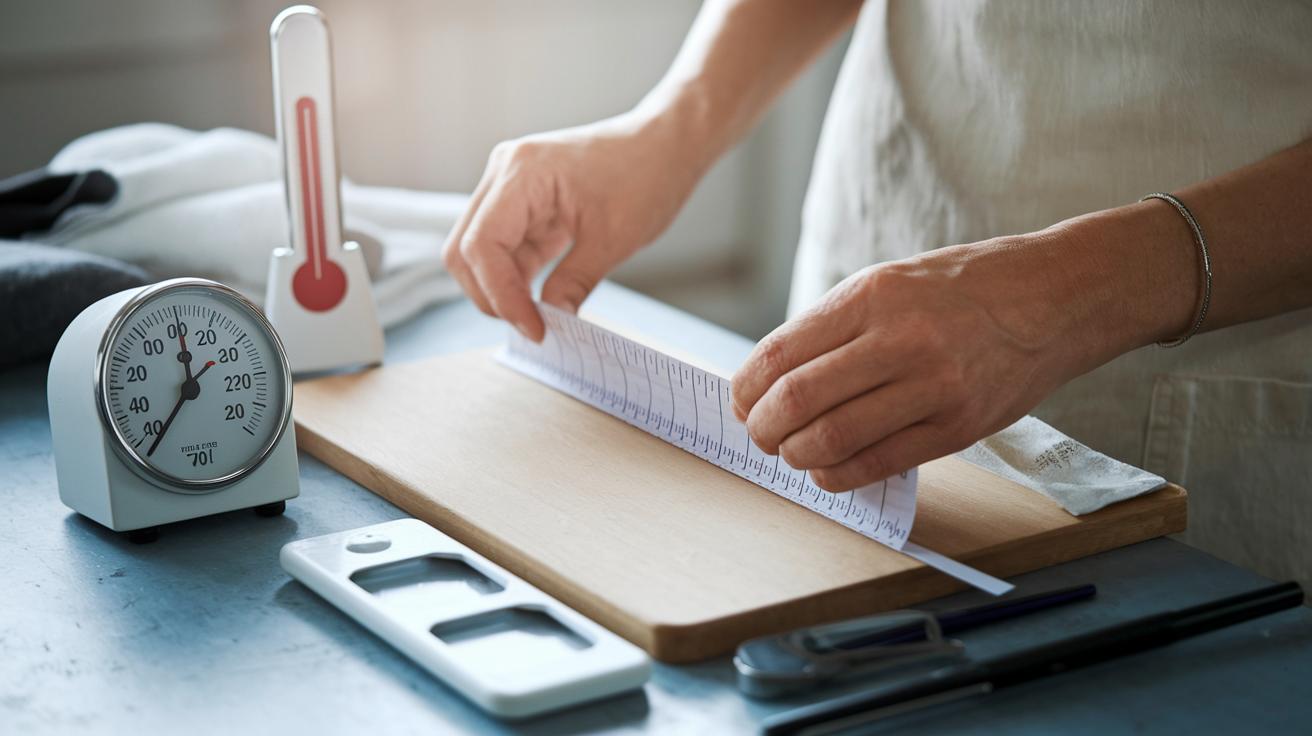
To get accurate stretch recovery results, measure each fabric sample three times and then average the numbers. This simple method cuts down on errors and makes your results more reliable.
Keep your tests indoors in a room that stays around 68 to 72°F with 40 to 60% humidity. A steady indoor setting stops temperature or moisture changes from messing up your test. For example, on a cool, dry day the room might hold steady at 70°F and 50% humidity, which helps the fabric react the same way each time.
Lay your fabric flat on a hard surface like a board or table. Make sure the fabric is not twisted at all. Keeping it flat and still helps you get the same measurement every time.
It also helps to check your digital calipers and scales every month (calibration means adjusting them so they read correctly). Regular checks keep your measurements spot-on. You might say, "I recalibrated the calipers last month, and they read accurately to 0.01 inches."
Wearing soft, non-abrasive gloves is another neat trick. This stops skin oils from touching the fabric and changing how the fibers react, which is especially important for fabrics that are sensitive to oils.
- Measure each sample three times and average the numbers
- Test indoors at 68–72°F with 40–60% humidity
- Lay fabric flat on a hard, untwisted surface
- Calibrate your tools monthly
- Wear non-abrasive gloves when testing
Following these steps will help make your home tests reliable and repeatable.
How to Interpret Clothing Stretch Recovery Test Results

When testing a fabric, two numbers matter: the recovery rate and the permanent set. The recovery rate tells you how much a fabric goes back to its normal size after it is stretched. The permanent set shows the amount that stays stretched even after the force is removed. A high recovery rate combined with a low permanent set means your garment will keep its shape longer.
Below are some common benchmarks for different fabric types:
| Fabric Type | Recovery Rate | Permanent Set |
|---|---|---|
| Spandex Blend | 85-95% | 5-15% |
| Polyester Knit | 70-85% | 15-30% |
| Cotton-Spandex | 60-75% | 25-40% |
| Wool Mix | 50-65% | 35-50% |
Use these numbers as a guide to see how well your clothing bounces back after being stretched.
Advanced Methods to Enhance Clothing Stretch Recovery at Home

If your clothes have lost their bounce back, you can try a couple of simple home fixes. First, mix water with a little hair conditioner to create a 1% solution (that means about 1 part conditioner to 99 parts water). Soak the fabric in this mix for 15 minutes at room temperature. Rinse it well afterward and then lay it flat to dry.
Next, use a warm iron to give the fabric a light steam treatment. Hold the iron gently over the stretched part for about 10 seconds. This warm, soft steam helps the fibers line up again and can improve the fabric’s ability to return to its original shape.
Always test these steps on a small, hidden spot, like an inside seam, before treating the entire garment. This way, you make sure the method works well with your fabric. These easy home tricks can boost the stretch recovery of your clothes and help them keep looking their best.
Final Words
In the action, this guide broke down how to test clothing stretch recovery at home. It covered everything from marking a fabric's baseline to applying the right stretch and measuring recovery with common tools. We shared tips to improve accuracy and even discussed how post-test treatments can boost fabric memory. By following these step-by-step techniques, you now have a practical approach to assess fabric performance. Enjoy the process and shop with the confidence that comes from knowing your garments will hold their shape.
FAQ
Q: Where can I find a demonstration of testing clothing stretch recovery at home on YouTube?
A: A test clothing stretch recovery video on YouTube shows you how to mark the natural fabric length, apply a weight for a set time, and measure recovery—all steps you can follow at home to gauge fabric performance.
Q: How do you test fabric for stretchability and recovery?
A: Testing fabric stretchability means marking a baseline length, applying a weight to elongate the material for a fixed time, then measuring how much it recovers. This helps indicate the fabric’s durability.
Q: Can you fix stretched out clothing?
A: Fixing stretched out clothing can involve treatment methods like a brief soak in a diluted hair-conditioner solution or light steam ironing under gentle tension to help the fibers regain shape.