

Have you ever noticed how some fabrics stay neat all day while others droop after a long day? Wrinkle tests show us the secret behind this.
We fold and press fabrics to see if they bounce back quickly. This simple test mimics the way we wear and store our clothes every day. It matters whether you're dressing for work or packing for travel, a fabric that stays smooth can make a big difference.
In this post, we break down exactly how these tests are done and look at the treatments that help fabrics fight off creases. Read on to see how a bit of science keeps your favorite clothes looking fresh.
Key Procedures in Clothing Wrinkle Resistance Testing
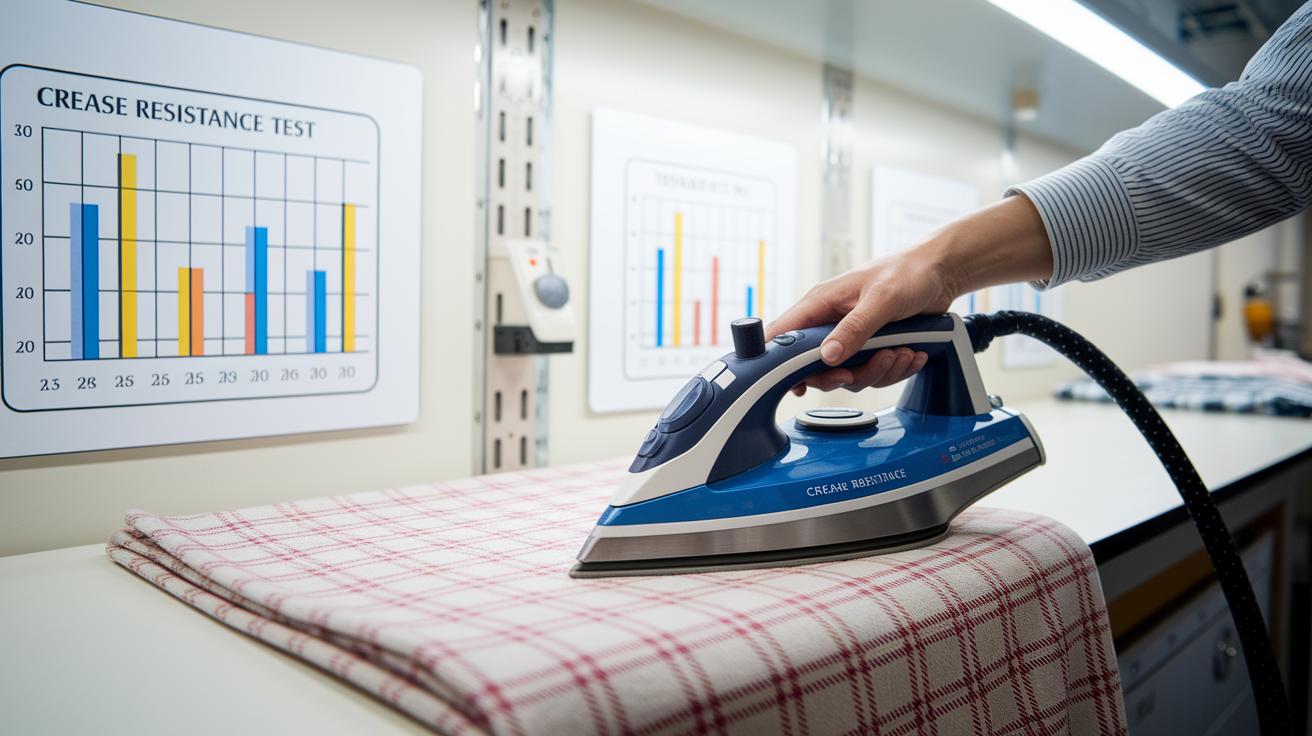
Wrinkle resistance tests show how well a fabric stays smooth after being folded and pressed during everyday use. They help designers, makers, and buyers check if a fabric keeps a neat look even after repeated wear. These tests are especially useful for work uniforms and travel clothes where a polished appearance is key.
Manufacturers use special treatments, like resin formulas applied to natural fibers, to improve wrinkle resistance. They blend in materials such as polyester, nylon, and a touch of spandex (2-5% for light stretch) to help the fabric bounce back into shape. They also work with tight weaves and high-twist yarns that give the fabric a memory-like effect, keeping creases to a minimum.
- Sample conditioning
- Folding or compression
- Recovery period
- Measurement of crease depth or recovery angle
- Comparison to industry standards
In testing, fabric samples are first kept in a controlled setting that mimics real-life conditions. Then, the fabric is folded or compressed to copy what happens during storage or wearing. After letting it rest for a set time, technicians measure the crease depth or recovery angle using standard tools. Durable-press resins, which bond cellulose and work for 20 to 50 washes, play an important role in the fabric's ability to stay smooth.
This step-by-step test links careful sample preparation with real-world performance to ensure that fabrics used in uniforms and travel wear can handle daily stress while still looking good.
Clothing Wrinkle Resistance Test Laboratory Protocols

We start by placing each fabric sample in a room set at 21 °C with 65% humidity. This steady condition gives the fibers a calm start, much like leaving a sweater in a room where everything is just right. It helps ensure that our wrinkle tests are fair and consistent.
Next, the samples go on special machines that fold, bend, and press the fabric at set pressures and angles. Think of the machine as a mechanical hand that squeezes the fabric to show any hidden weak spots.
Finally, our technicians note how quickly the fabric returns to its original shape after being stressed. This measurement is important for checking wrinkle resistance. We also test fabrics after 20 to 50 wash cycles to see how well the durable-press resin (a chemical treatment that keeps fabrics crease-free) holds up over time.
Evaluating Garment Performance Metrics and Wrinkle Recovery Assessment

We measure garment performance using three main values: crease recovery angle, the number of wrinkles you can see, and a smoothness rating from 1 to 5 (where 5 means really smooth).
Each fabric sample rests for 5 minutes before we test it under steady conditions. We run the test several times to make sure our results are spot on. One tester said the material kept a 4 out of 5 smooth score even after 30 washes, which shows that the durable-press resins work well. For more on testing fabric durability at home, check out How to Test Clothing Durability at Home.
Fabrics that bounce back well from creases and show few wrinkles in the lab are likely to keep a sharp look during your busy work days and travel.
Understanding Wrinkle Performance Testing Standards and Crease Durability Protocols

Fabrics are put through 10 to 20 fold cycles to copy how we wear them every day. After these folds and washes, technicians check how many creases stay visible to see how strong the fabric is. A common goal is to reach a 3 out of 5 rating after 30 washes, showing that the fabric holds up well. These rules have been used since the late 1900s and are updated as new textile technology and fiber blends come out. The tests check how well the fabric resists creases and bounces back to a smooth look. This ensures that the material works well for uniforms and travel clothes.
Manufacturers use standard tests that set clear grades for crease durability. In these tests, garments are folded repeatedly, and then experts measure how quickly the fabric returns to its smooth state. This process not only backs up the wrinkle test but also shows how strong the fabric really is. Labs then compare how well each fabric recovers against set standards. Their consistent and clear results help manufacturers improve their products and let customers know what to expect from wrinkle-proof clothing.
Applications and Best Practices for Non-Iron Material Evaluation and Crease Proof Performance

Non-iron fabrics are a hit in hospitals, hotels, and on airplanes. They are also great for travel clothes that need to look neat straight out of your bag. These fabrics are treated with resin finishes (a special coating that keeps them smooth) and mixed fibers that help the material stay crease-free even after folding.
They work well for anyone who wants clothes that look tidy with little extra care. New eco-friendly options, like enzyme finishes (using natural substances), plant-based resins, and nano-silica coatings (tiny protective particles), do a solid job at keeping the fabric looking fresh. Manufacturers test these fabrics for wrinkle recovery and suggest simple care tips to extend their life.
Here are some easy care tips:
| Tip | Description |
|---|---|
| Mild Detergents | Stick with gentle cleaners and limit wash cycles to protect the resin finish. |
| Low-Heat Drying | Use a low setting in your dryer to keep the fabric strong. |
| Proper Storage | Hang your clothes or lay them flat to avoid extra pressure folds. |
| Gentle Re-Pressing | If you need to remove wrinkles, opt for a gentle re-press room rather than high-heat ironing. |
These easy steps will help your non-iron garments keep their crisp look day after day.
Final Words
In the action, we break down key steps like sample conditioning, folding, recovery, measurement, and scoring to reveal how fabrics hold up under pressure. We discussed how test data links back to real-life garment use and care tips, all through a detailed look at lab protocols and performance ratings.
This guide on clothing wrinkle resistance test explained offers clear insights into fabric resilience and wear durability. It leaves you armed with practical knowledge to choose and care for clothing that stays sharp.
FAQ
Clothing wrinkle resistance test explained pdf
The clothing wrinkle resistance test explained pdf typically outlines how fabrics are tested by conditioning, folding, allowing recovery, then measuring crease angles to score wrinkle resilience objectively.
Cotton clothing wrinkle resistance test explained
The cotton clothing wrinkle resistance test explained details how cotton fabrics are conditioned, compressed, and then evaluated for how well they bounce back, ensuring they stay smooth after wear and washing.
What is the wrinkle resistance test method?
The wrinkle resistance test method involves folding or compressing fabric samples under controlled conditions, letting them recover, measuring crease or recovery angles, and scoring them against set industry standards.
Which fabric is most wrinkle-resistant?
The fabric most wrinkle-resistant is usually a blend of polyester and natural fibers or cotton treated with durable-press finishes, thanks to tight weaves, high-twist yarns, and added spandex that help the fabric hold shape.
What is 3.5 DP rating?
A 3.5 DP rating refers to a fabric scoring on a 1–5 scale measuring wrinkle recovery; it indicates above-average performance, meaning the fabric largely returns to its original smooth state after being creased.
What is the meaning of wrinkle resistance?
The meaning of wrinkle resistance is a fabric’s ability to recover from creasing after pressure; it quantifies how well a garment maintains a smooth look, even after regular movement and washing.