

Ever wondered why your press-on nails sometimes feel too tight or pop off unexpectedly? The secret is in finding the right size.
This guide shows you how to measure your nails and read the size chart in simple steps. It helps you see which size works best for each finger so you can avoid common mistakes. Follow along, and you'll soon enjoy press-ons that look good and feel comfy all day.
Press-On Nail Measurement Guide for a Perfect Fit
Getting the right press-on nail size is key for a comfy fit and long-lasting wear. Nails that are too small can feel tight and pop off, while nails that are too big stick out and look heavy. A full set usually has 10 to 12 sizes for each hand, starting at size 0 (the biggest) and going down to size 9 or 11 (the smallest).
Measure each nail at its widest point with a soft measuring tape or a narrow adhesive strip. Write down each measurement in millimeters. You might notice one size appears most often, and that common measurement is usually your best bet for a uniform look.
If a measurement falls between sizes, pick the larger one and gently file it down. This way, your nails are not squeezed while still looking natural. Using the same method for all ten nails helps keep your manicure even.
Following this guide lets you compare brand charts easily and pick a set that fits your hand shape and nail width. Stick to these steps to avoid common mistakes and enjoy a press-on look that stays put all day.
Understanding the Press-On Nail Size Chart and Dimensions
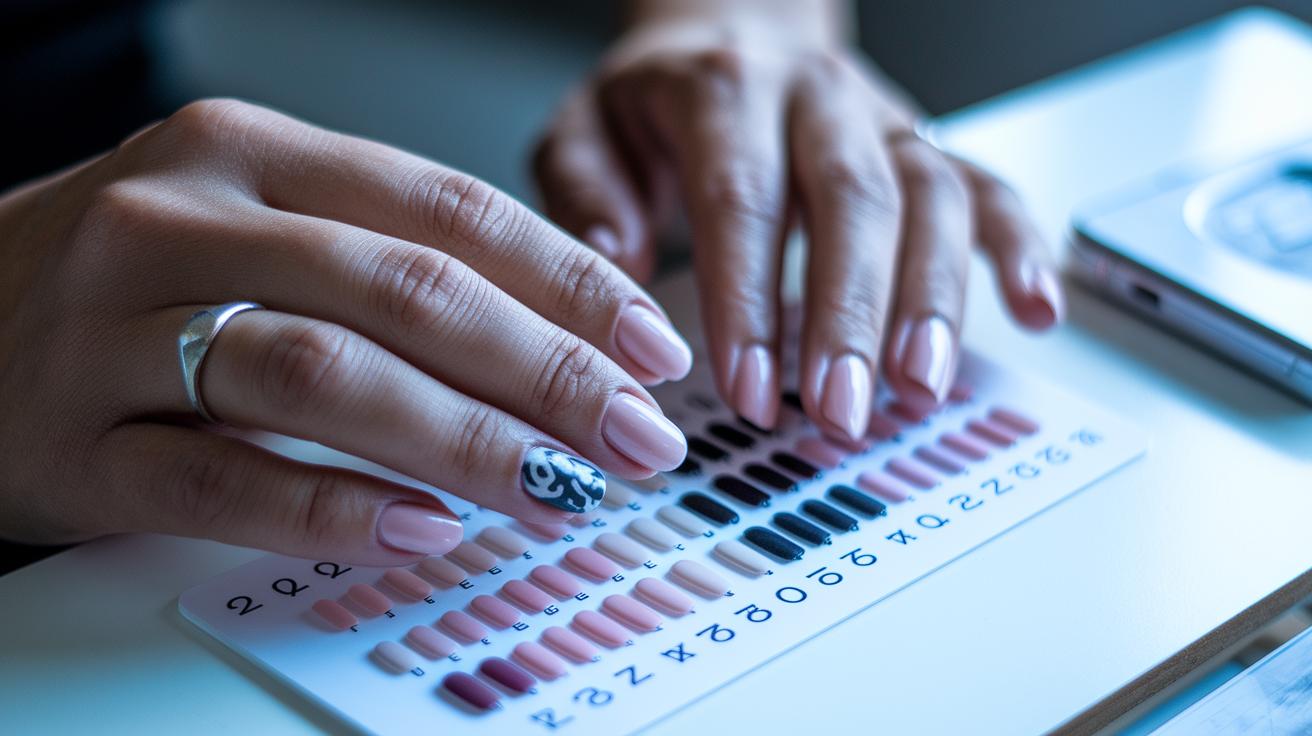
Press-on nail charts show measurements for each finger. They list details like the size number, the specific finger, and the nail's width in millimeters (mm, a measure of how wide the nail is).
For instance, you might see a chart that looks like this:
| Size Number | Finger | Width (mm) |
|---|---|---|
| 0 | Thumb | 14 |
| 1 | Index | 11 |
| 2 | Middle | 12 |
| 3 | Ring | 10 |
| 4 | Pinky | 9 |
This example shows how many brands use millimeters to list nail widths. They usually measure at the widest point of your nail so you know exactly what to expect. Keep in mind that size numbers can differ from one brand to the next. One brand might start with size 0 for the thumb, while another might use a different system.
When you see a line like, "Size 0 – Perfect for your thumb at roughly 14 mm," it instantly tells you which nail fits best. With these clear details, you can compare different brands and pick the set that matches your natural nail shape.
How to Measure Your Natural Nails at Home
Follow these simple tips to get accurate nail measurements at home. If your finger sizes differ, write them down and pick the size you see most often when choosing your press-ons.
- Pick the tool that works best for you. A soft measuring tape moves with your nail's curve, but a thin, sticky strip gives you a straight edge.
- If a measurement seems odd, measure again to check for any slipping or bending. For example, if your index finger shows 10 mm but your ring finger shows 12 mm, re-measure each one to be sure.
- Make sure the tool lies flat on the widest part of your nail. An off-angle tool can give misleading measurements.
If your numbers still vary, note down all the measurements and either average them or use the most common value. For instance, writing down 12 mm for your thumb and 11 mm for your index finger can help you spot any mistakes and find the best measurement to use.
Conversion Charts: Inches, Millimeters, and Centimeters for Nail Fits

Using a conversion chart makes comparing press-on nail sizes easy. When you see widths listed in different units, knowing the conversion helps you pick the right nail. For example, if a chart shows a 10 mm width, that means about 0.39 in or 1.0 cm. If your nail measures 12 mm, that's roughly 0.47 in, a good tip when ordering internationally where only inches might be listed.
Different regions use different measurement systems. In the United States, you'll mostly see inches, while European charts often use millimeters or centimeters. Keeping a quick-reference table nearby makes shopping across brands and sites simpler.
Here are a few quick comparisons:
- 8 mm equals about 0.31 in or 0.8 cm.
- 10 mm equals about 0.39 in or 1.0 cm.
- 12 mm equals about 0.47 in or 1.2 cm.
- 14 mm equals about 0.55 in or 1.4 cm.
| Millimeters (mm) | Inches (in) | Centimeters (cm) |
|---|---|---|
| 8 | 0.31 | 0.8 |
| 10 | 0.39 | 1.0 |
| 12 | 0.47 | 1.2 |
| 14 | 0.55 | 1.4 |
When checking sizes, start by measuring in millimeters and then match that number to its inch or centimeter equivalent. This method helps you avoid sizing mistakes and makes it easier to compare products from different brands.
DIY Press-On Nail Template and Free Printable PDF
Start by gathering a few simple materials: plain paper, a pen, and a pair of scissors. Lay your hand gently on the paper and trace around each nail using a fine-tip marker. For instance, draw a clear outline that follows your natural nail curve and mark its widest point.
Once you have your nail outlines, cut each shape out carefully. Then, place these cutouts on a clear sheet or even on your phone screen. This helps you check if each shape matches your nail and lets you spot any differences before you make your final template.
Now, scan or take a photo of your paper traces to turn them digital. Open the image on your computer and add a simple size chart using an image editor. The chart should show size numbers, nail widths in millimeters (how wide each nail is), and a note about which finger the shape fits best. Adjust the outlines until they line up with the chart correctly.
- Use a soft measuring tape to record the widest part of your nail trace.
- If your size is between two options, choose the larger size and trim it down with a nail file.
- Make sure the digital overlay is clear before printing it out.
Some brands offer free downloadable nail template PDFs. Print these out, trace your nails on them, and compare directly with the guide for a custom fit. Try out a few templates until you find the one that works best for a smooth, easy application.
Press on nail size chart: Get Your Perfect Fit

Different nail shapes affect how you should size your press-ons. Almond and oval styles tapers make the nails look longer and slimmer. This means they often need a base that is a bit larger to match your natural nail. If your almond nails feel snug at the base, check for a size with a wider measurement. That extra room gives you space to file them gently until they follow your natural nail curve.
Coffin-shaped nails have a square tip and a shorter free edge. They feel more compact, and the base might seem small compared to the rest of the nail. When you use the size chart, make sure to look at the width measurements, especially if the nail has a curved tip.
Try these tips to avoid a tight or bulky look:
- Measure the widest part of your nail carefully.
- Compare your measurements with the style you want.
- Remember that a tapered shape might need a larger size.
Following these sizing tips can help you achieve a natural look with a secure, professional fit for your press-on nails.
Common Sizing Mistakes and Accuracy Tips for Faux Nails
When measuring press-on nails, a frequent mistake is to use a pen to mark your nail edge. This can make your nail look wider than it really is. Think of it as drawing a line that adds extra width you don't actually have.
Another handy trick is the coin method. A typical U.S. penny is about 19 mm wide. Hold one next to your nail to quickly check its width. I once compared my index nail with a penny and found my earlier measurement was a bit off.
Before you settle on a nail size, try a test fit. Place your press-on nails on your natural nails to see if they feel comfortable and secure. This way, you can tell if you need to choose a slightly larger size and file it down.
By following these simple steps, you can avoid common mistakes and enjoy a press-on manicure that looks natural and fits well.
FAQs on Press-On Nail Sizing and Fit

What should you do if your nail measurement is between two sizes?
Go with the larger size and gently file off the extra part. This lets you trim it down for a snug fit while keeping the glue strong.
Example: "Choose the larger nail and lightly file the edges so it fits well."
Why might press-ons feel too loose or too tight?
If a press-on feels tight, the size might be too small. If it sticks out past your natural nail, it can feel bulky. Measure your nail at its widest point using a soft tape measure to check. Then, pick a different size if needed.
Example: "If something feels off, measure your nail with a soft tape and try a larger or smaller size accordingly."
How should you use brand-specific charts like the Makartt guide?
Follow the measurements provided by each brand closely. These charts list sizes in millimeters (mm, which is a unit that shows the nail's width) so compare them with your own nail sizes.
Example: "Review the Makartt guide for detailed mm measurements, then match your nail to the closest size."
What care tips are recommended after applying press-ons?
For the first 24 hours, keep your nails dry and avoid long water exposure. When cleaning your hands, try not to soak your nails, and consider adding a top coat polish to secure the adhesive better.
Example: "After putting them on, let your nails rest for a day and avoid water to help the glue hold."
What should you do if you notice the adhesive losing its hold?
Make sure both your nail and the press-on are completely dry before you stick them on. Adding a small extra drop of glue along the edge can help, but use it sparingly.
Example: "If the glue seems weak, dry your nails well and apply a tiny bit of extra adhesive along the edges for a firmer grip."
Final Words
In the action, we broke down how to read a press on nail size chart and why the correct fit matters. We covered measuring your nails, converting millimeters to inches, and using a DIY template for a better match. Simple tests and tips were shared to avoid common sizing errors. Practical guides and FAQs help make ordering press-ons a safer bet. Follow these steps for a comfortable and stylish nail fit every time. Enjoy the process and feel confident in your nail game.
FAQ
What are the common formats for a press-on nail size chart?
The common press-on nail charts appear on platforms like Reddit and as downloadable PDF templates. They list sizes in millimeters, centimeters, or inches to help match your natural nails for a secure fit.
How do different measurement units affect press-on nail size charts?
Press-on nail size charts list dimensions using various units. They typically show widths in millimeters, while some charts convert them into inches or centimeters to help ensure a proper match with your nail measurements.
Are press-on nail sizes universal?
Press-on nail sizes are not universal. Each brand uses its own sizing chart, so it’s best to review the specific measurements provided to get the most accurate fit for your nails.
How do I know what size press-on nails I need?
Knowing your press-on nail size starts with measuring your natural nail widths. Compare these measurements to the brand’s size chart to find the best matching size for each finger.
Is 16d bigger than 10d?
The labels 16d and 10d refer to nail size indicators, with higher numbers typically indicating longer or larger nails. Still, review the specific brand’s measurements since sizing labels can vary between manufacturers.
How long are XS nails?
XS nails are meant for smaller nail beds and are generally shorter in width and length. Check the brand’s size chart for the exact measurements to ensure a comfortable and natural look.
How can I tell if press-on nails are too big?
Press-on nails feel too big if they extend past your natural nail edges or if they do not securely overlap your nail borders. A proper fit means the nail contour closely follows your natural nail shape.